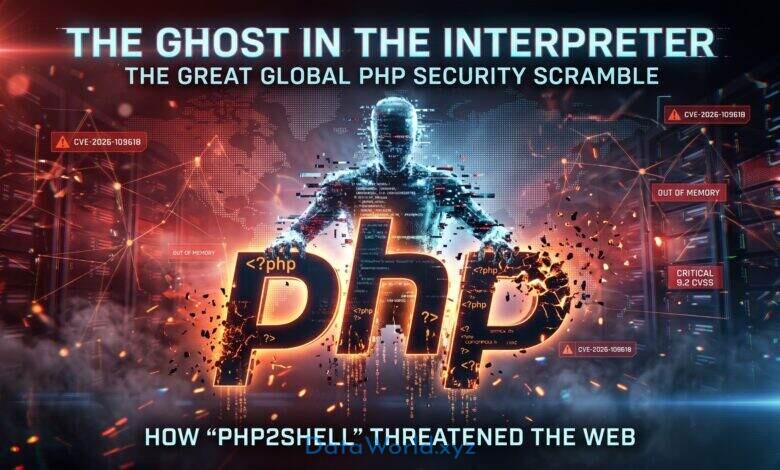
The Ghost in the Interpreter: How “PHP2Shell” Sparked the Great Web Scramble of 2026
The Ghost in — Key Insights & Complete Guide
Furthermore, if you are looking for accurate and comprehensive information about The Ghost in, this detailed guide walks you through every essential aspect. Therefore, we explore the core strategies and practical insights regarding The Ghost in. Finally, by following these proven best practices and step-by-step recommendations, you can achieve optimal results quickly and effectively.
For over thirty years, PHP has functioned as the unglamorous load-bearing wall of the modern internet. Powering roughly 75% of all websites with a known server-side language—from sprawling WordPress media empires and Magento storefronts to critical government portals—it is everywhere. In October 2026, that ubiquity turned into a synchronized global headache.
When the PHP development team issued an emergency pre-notification for two critical vulnerabilities (both carrying a severe 9.2 CVSS v4.0 rating), incident response teams from San Francisco to Wellington brewed pots of midnight coffee and opened crisis channels. Dubbed PHP2Shell (CVE-2026-109618 and CVE-2026-109619), the flaws didn’t just target a bad plugin or a misconfigured database. They lived inside the core PHP engine itself, allowing unauthenticated attackers to hijack servers before a website’s own security code even had a chance to wake up and run.
Anatomy of a Pre-Script Hijack
Most web vulnerabilities happen at the application layer: a developer forgets to sanitize an input field, and an attacker slips malicious instructions through the cracks. PHP2Shell was far more insidious because it occurred during the request lifecycle—the split second when the PHP interpreter prepares incoming data before handing it over to the website’s scripts.
Because the flaws existed in how the engine handles raw HTTP requests and memory cleanup, application-level firewalls, login screens, and clean codebases offered zero protection.
| Vulnerability ID | Core Mechanism | How the Trap Triggers | Primary Mitigation |
|---|---|---|---|
| CVE-2026-109618 | Out-of-Memory (OOM) Corruption | An oversized request forces PHP to run out of memory mid-parse, using longjmp() to abort. The cleanup routine then mistakenly processes uninitialized, attacker-controlled memory as valid instructions. |
Patch to 8.5.12 / 8.4.27 / 8.3.36 / 8.2.35; restrict post_max_size at the proxy boundary. |
| CVE-2026-109619 | Stale Global State (Use-After-Free) | After a fatal error or upload interruption, a PHP worker fails to wipe its internal state. The next request hitting that same worker inherits dangling pointers to freed memory, leading to remote code execution. | Apply core patches; set session.upload_progress.enabled = 0 and fatal_error_backtraces = 0. |
While every web-serving PHP setup—including PHP-FPM, php-cgi, FrankenPHP, and LiteSpeed—fell under the blast radius, traditional Apache mod_php environments faced the steepest risk, capable of yielding full shell access in a single unauthenticated request.
The AI Inflection Point
What turned PHP2Shell from a standard patch cycle into a historic inflection point wasn’t just the severity of the bugs—it was how they were uncovered.
These memory-safety flaws had quietly lurked in the PHP codebase for years. Finding them required tracing deeply convoluted interactions between C-level memory allocations, multipart/form-data uploads, and error-handling jumps. Rather than stumbling across them through traditional human code audits or basic fuzzing, researchers at security firms Wiz and Calif independently surfaced and weaponized the bugs in the lab using frontier AI models—specifically pairing Wiz Atlas, Google’s Gemini 4 Argon, and OpenAI’s GPT-5.6 Sol.
For years, the cybersecurity industry debated when AI would move beyond summarizing log files to autonomously discovering deep, multi-stage zero-days in foundational open-source software. PHP2Shell answered the question. AI agents didn’t just flag a suspicious line of code; they mapped out the exact memory-exhaustion choreography needed to turn a theoretical glitch into reliable Remote Code Execution (RCE).
72 Hours on the Digital Frontline
The timeline of the scramble revealed a razor-thin margin between coordinated defense and mass exploitation.
- Silent Zero-Day Probes
October 17, 2026
Four days before public disclosure, AWS and Amazon threat intelligence sensors detect early, targeted attempts to exploit the PHP flaws in the wild, sparking urgent behind-the-scenes coordination. - The 24-Hour Warning Shot
October 20, 2026
The PHP Foundation issues a rare, cryptic heads-up: two critical 9.2-rated vulnerabilities will be patched the following day. Rumors and flawed DIY workarounds immediately flood developer forums. - Leaks and WAF Shields
October 21, 2026 (Early UTC)
Ten hours before the official release, details of the vulnerabilities leak. Cloudflare registers thousands of exploit attempts across its network and deploys emergency Web Application Firewall (WAF) rules along with Fastly, Akamai, and CrowdStrike. - Patches Drop Worldwide
October 21, 2026 (13:30 UTC)
The PHP team releases patched versions (8.5.12, 8.4.27, 8.3.36, and 8.2.35) alongside an unusual gift: minimal source-code backports for end-of-life branches (7.4, 8.0, and 8.1) to prevent a global catastrophe. - The Aftershock Advisory
October 23, 2026
As CISA and global CERTs mandate immediate patching, PHP issues a follow-up advisory urging administrators to disablesession.upload_progress.enabledto close off a secondary RCE vector (CVE-2026-115560).
The Long Tail of Legacy Tech
While major cloud providers like Google Cloud and AWS quickly rolled out updated serverless runtimes and base images, the true crisis settled over the internet’s “long tail”.
Telemetry collected by Censys and Qualys during the height of the scramble painted a sobering picture: over 36.7 million internet-facing services and 167 million PHP package installations sat in the crosshairs. Worse still, roughly half of the exposed servers in several major economies were running end-of-life PHP versions (like PHP 7.x) that no longer receive automated package updates.
For small agencies and enterprise IT teams alike, the scramble forced a brutal triage. Some government agencies and businesses temporarily pulled their portals offline behind static holding pages rather than risk database theft. Others discovered that “stopgap” configuration tweaks circulating on social media failed to block the memory-exhaustion vector unless paired with strict reverse-proxy request limits.
What the Scramble Leaves Behind
The Great PHP Scramble of 2026 will be remembered as a dress rehearsal for a new era of infrastructure defense. First, it proved that edge protection buys time, not immunity—WAF providers held the line when the exploit leaked early, but subtle payload mutations quickly showed that only binary patching cures a core interpreter flaw.
Second, it exposed the quiet debt of abandoned software. The internet runs on code written a decade ago, and now that autonomous AI models can systematically audit that code for forgotten memory traps, the grace period for running unmaintained servers has officially expired.


