
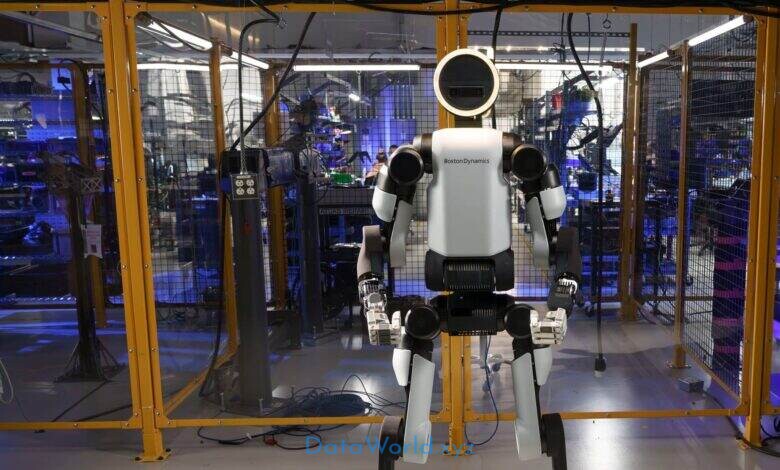
Atlas Humanoid Robot
# Boston Dynamics Atlas: The Evolution, Specifications, and Future of the World’s Most Dynamic Humanoid Robot
## 1. Introduction
Atlas is an advanced bipedal humanoid robot developed by the American robotics company **Boston Dynamics** (now majority-owned by Hyundai Motor Group). Originally unveiled to the public in July 2013 as a search-and-rescue research platform funded by the U.S. Defense Advanced Research Projects Agency (DARPA), Atlas quickly became a global icon of robotics due to its unprecedented agility, balance, and parkour capabilities.
In **April 2024**, Boston Dynamics officially retired its famous hydraulic-powered Atlas (known internally as *HD Atlas*) and unveiled an **all-new, fully electric Atlas** designed specifically for real-world commercial and industrial applications, moving from a laboratory research project to a viable factory-floor workforce solution.
—
## 2. The Two Generations of Atlas
### Generation 1: Hydraulic Atlas (HD Atlas, 2013–2024)
The original Atlas relied on a complex hydraulic actuation system. Over a decade of development, it underwent major redesigns utilizing 3D-printed titanium and aluminum parts to integrate fluid lines directly into its skeletal structure. It became world-famous for performing backflips, navigating complex parkour obstacle courses, dancing, and manipulating heavy construction materials. Despite its athletic prowess, high maintenance costs and hydraulic fluid pressure risks made it unsuitable for commercial mass production.
### Generation 2: Fully Electric Atlas (2024–Present)
Revealed in April 2024, the second-generation Atlas eliminates hydraulics entirely in favor of custom-designed high-torque electric actuators. The new design features a sleeker profile, a circular ring-light “head” interface, and joints capable of rotating a full **360 degrees**. Unlike the hydraulic version, which mimicked human range-of-motion constraints, the electric Atlas moves in superhuman ways—turning its head, torso, and hips completely backward to operate efficiently in tight industrial workspaces without needing to take steps to turn around.

## 3. Comprehensive Technical Specifications
Below is a side-by-side comparison of the retired Hydraulic Atlas and the current All-Electric Commercial Atlas:
| Feature / Specification | Hydraulic Atlas (Retired 2024) | Electric Atlas (Current Generation) |
| :— | :— | :— |
| **Developer** | Boston Dynamics | Boston Dynamics (Hyundai Motor Group) |
| **Primary Purpose** | R&D, Agility & Control Research | Commercial Manufacturing & Logistics |
| **Height** | ~1.5 meters (5 feet) | ~1.5 meters (5 feet) |
| **Weight** | 89 kg (196 lbs) | ~80–85 kg (Lighter, high-strength frame) |
| **Actuation System** | Custom Hydraulic Actuators (28 joints) | High-Torque Custom Electric Actuators |
| **Joint Mobility** | Human-like range of motion | 360-degree continuous rotation in major joints |
| **Power Source** | Onboard Lithium-Ion Battery Pack | High-Density Swappable Industrial Battery |
| **Vision & Perception** | RGB Cameras, LiDAR, Depth Sensors | Multi-spectrum Time-of-Flight (ToF), Depth & RGB Sensors |
| **Gripper / Hands** | 2-finger / claw-style research grippers | Modular multi-fingered dexterous grippers |
| **Strength / Payload** | Up to 11 kg (25 lbs) dynamic lifting | Exceeds human strength across full range of motion |
| **Onboard Computing** | Three onboard control computers | Next-gen AI & Edge-ML compute processors |
—
## 4. Key Technological Features of the New Electric Atlas
### A. Superhuman Range of Motion (360° Joints)
Instead of being limited by human biological mechanics, the electric Atlas features swiveling hip, spine, and neck joints. If the robot picks up a part from a bin in front of it and needs to place it on a conveyor belt directly behind it, it simply rotates its torso and legs 180 degrees in place rather than turning its entire body around.
### B. Advanced AI and Reinforcement Learning (RL)
Powered by Boston Dynamics’ partnership with the **Robotics and AI Institute (RAI)** and **Toyota Research Institute (TRI)**, Atlas uses Large Behavior Models (LBMs) and Reinforcement Learning. It can autonomously perceive objects, estimate weight and geometry, adapt to slipping or misplaced items in real time, and recover instantly from unexpected physical disturbances.
### C. Dexterous Manipulation
Boston Dynamics developed new multi-fingered end-effectors (hands) equipped with tactile and force-feedback sensors. This allows Atlas to handle delicate items as well as heavy automotive components such as engine struts, sheet metal fixtures, and storage totes.
### D. Orbit Fleet Management Integration
The commercial Atlas integrates with **Orbit**, Boston Dynamics’ enterprise software platform (already used by their quadruped robot, *Spot*, and logistics robot, *Stretch*). Facility managers can monitor battery status, assign tasks, analyze workflow data, and integrate Atlas directly into existing factory IoT systems.
—
## 5. Real-World Applications and Use Cases
1. **Automotive Manufacturing:** Hyundai Motor Group serves as the primary testing ground and initial customer for the electric Atlas. The robot is actively being tested to sort car parts, sequence components for assembly lines, and load/unload heavy machine fixtures.
2. **Warehousing and Logistics:** Operating alongside Boston Dynamics’ *Stretch* robot, Atlas can navigate narrow warehouse aisles, climb stairs or ladders, and organize irregular inventory items that standard wheeled robots cannot reach.
3. **Hazardous Environments:** Because it mimics the human form factor, Atlas can use tools, doors, stairways, and workstations built for humans inside high-risk chemical plants, nuclear facilities, or extreme-temperature zones.
—
## 6. Conclusion
The transition of Boston Dynamics’ Atlas from a hydraulic research marvel to a fully electric, AI-driven commercial humanoid marks a defining moment in modern robotics. By combining decades of dynamic balance control with modern generative AI and superhuman electric actuation, Atlas is poised to redefine industrial automation and work alongside humans in the factories of the future.